
.webp)

.webp)
.webp)
.webp)


.svg)
.svg)

Introduction
Applying for your first loan can feel like a catch-22.
You need a credit history to improve your chances of getting approved. But until you receive your first loan and repay it responsibly, you don't have much of a credit history to begin with.
It's a concern many first-time borrowers have, especially young professionals, self-employed individuals, and homeowners who have always avoided borrowing.
The good news is that a missing credit history doesn't automatically close the door on financing. Today, many lenders look beyond just a credit score to understand whether an applicant can comfortably repay a loan.
If you're planning to install rooftop solar, understanding solar loan eligibility can help you prepare a stronger application before you even submit it.
Why Lenders Usually Ask for Credit History
When a lender reviews a loan application, they're trying to answer one question.
"Is this borrower likely to repay the loan on time?"
A credit history helps provide part of that answer. It gives lenders a record of how previous loans or credit cards have been managed, whether repayments were made on schedule, and how consistently the borrower has handled debt.
That's why applicants are often asked about their CIBIL score for solar loan applications.
However, a credit score is only one part of the overall assessment. Having little or no borrowing history is different from having a poor repayment history. Lenders understand this distinction, and many consider additional factors before making a decision.
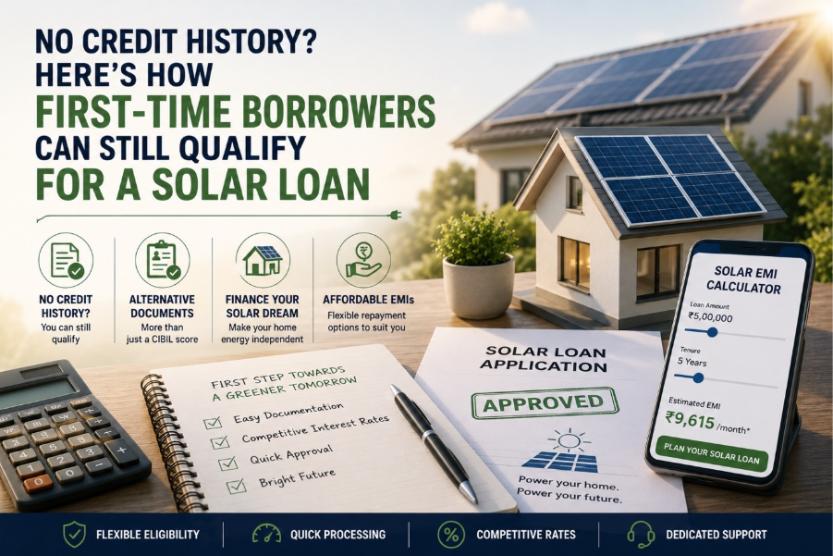
Can You Get a Solar Loan Without a Credit Score?
In many cases, yes.
Several financial institutions, particularly NBFCs and specialized clean energy lenders, recognize that first-time borrowers may not have an established credit profile.
Instead of relying only on a credit score, they often evaluate whether the applicant has a stable source of income, regular banking activity, and the ability to manage monthly repayments.
That means a solar loan without a CIBIL history is possible in some situations, although the final decision always depends on the lender's assessment and lending policy.
The stronger the supporting documents, the easier it becomes for the lender to understand your repayment capacity.
Alternative Data Lenders Use Instead of CIBIL
If there's little or no credit history available, lenders often build a broader picture using other financial information.
Some of the factors they may review include:
- Monthly income.
- Employment stability.
- Business income for self-employed applicants.
- Bank account activity.
- Existing financial commitments.
- Utility payment behavior.
- Savings patterns.
Taken together, these details help lenders understand whether the applicant is likely to manage future repayments comfortably.
How NBFCs Differ from Banks for First-Time Borrowers
Banks and NBFCs both offer financing, but they don't always assess applications in exactly the same way.
Banks often follow more standardized lending processes, particularly for applicants with limited borrowing history.
Many NBFCs, on the other hand, use a more flexible approach for specific loan products. Rather than depending entirely on one number, they may consider a wider range of financial information while evaluating applications.
That flexibility has made NBFCs an important financing partner for many first-time borrowers looking at loans for solar installation.
Of course, approval policies differ from one institution to another, so it's always worth checking the eligibility criteria before applying.
Documents That Strengthen Your Application Without a Credit History
Good documentation helps lenders understand your financial profile more clearly.
Even without an established credit score, organized paperwork often makes the application process much smoother.
Many solar loan approval documents remain the same regardless of whether you're a first-time borrower or someone with previous credit history.
Income Proof
Steady income is one of the strongest indicators of repayment capacity.
Depending on your employment type, lenders may ask for:
- Salary slips.
- Form 16.
- Income Tax Returns.
- Business financial statements.
- GST filings for eligible businesses.
The objective is to understand whether your monthly income comfortably supports the proposed loan repayment.
Bank Statements
Recent bank statements often provide useful insight into day-to-day financial management.
Lenders typically review:
- Salary or business credits.
- Regular savings.
- Existing loan repayments, if any.
- Average account balance.
- Frequency of returned transactions.
Consistent banking behavior generally creates greater confidence during the assessment process.
Utility Bill Payment Record
Although utility bills don't replace a credit history, timely payment records can sometimes support an overall assessment.
Electricity, water, and other recurring household payments demonstrate a pattern of meeting regular financial obligations.
When combined with income proof and bank statements, they help present a more complete financial picture.
Role of a Co-Applicant or Guarantor
If you're applying for your very first loan, adding a co-applicant can sometimes strengthen your application.
A co-applicant shares responsibility for repaying the loan and gives the lender an additional financial profile to evaluate. This could be a spouse, parent, or another eligible family member, depending on the lender's policy.
Some lenders may also accept a guarantor for certain loan products, although this varies from one institution to another.
Adding a co-applicant doesn't guarantee approval, but it can provide lenders with greater confidence when assessing a first-time borrower.
How Down Payment Amount Affects Approval Odds
The amount you contribute upfront can influence how a lender views your application.
A higher down payment reduces the loan amount, which in turn lowers the lender's exposure. It also demonstrates that you're financially prepared to invest in the project yourself.
For example, imagine two applicants purchasing the same rooftop solar system.
Both have similar incomes, but one chooses to finance the entire amount while the other contributes a portion of the cost upfront. The second application may appear less risky simply because the loan amount is lower.
It's always worth asking your lender whether a higher down payment could improve the structure of your loan or reduce the repayment burden.
Building Credit History Through Your First Solar Loan
Your first loan isn't only about financing a rooftop solar system. It can also become the foundation of your future credit profile.
Every EMI paid on time contributes to your repayment history. Over time, this helps build a stronger credit record, which may make future borrowing easier for larger financial goals such as a home loan, education loan, or business finance.
That's why it's important to choose an EMI that comfortably fits your monthly budget.
Borrowing responsibly today can create more financial flexibility in the years ahead.
Tips to Improve Approval Chances as a First-Time Borrower
There's no guaranteed formula for loan approval, but a few practical steps can make your application stronger.
Before applying:
- Check that all documents are complete and up to date.
- Ensure your income details match the information in your bank statements.
- Avoid submitting multiple loan applications within a short period.
- Consider applying with a co-applicant if appropriate.
- Decide on an EMI that comfortably fits your monthly income.
- Be transparent about existing financial commitments.
Lenders appreciate applications that are complete, consistent, and easy to verify.
Common Reasons First-Time Loan Applications Get Rejected
Receiving a rejection can be disappointing, but it doesn't always mean you're ineligible for future financing.
Some of the more common reasons include:
- Incomplete documentation.
- Income that doesn't comfortably support the proposed EMI.
- Inconsistent information across application documents.
- Frequent returned payments in recent bank statements.
- Existing financial obligations that significantly affect repayment capacity.
- Applying for a loan amount that's much higher than current income can reasonably support.
Understanding why an application wasn't approved often helps applicants prepare a stronger one the next time.
How Aerem Makes Solar Financing Simpler
Financing a rooftop solar system should feel straightforward, especially if it's your first loan.
Aerem works with financing partners who understand that every applicant has a different financial journey. Rather than focusing only on a single metric, the aim is to help homeowners explore financing options that suit their income, repayment capacity, and long-term goals.
Before applying, you can also use a solar EMI calculator to estimate monthly repayments based on the loan amount and repayment tenure. Having a clear idea of your expected EMI makes it easier to plan your finances and choose a loan structure that's comfortable over the long term.
Whether you're exploring loans for solar installation for the first time or comparing different financing options, better preparation often leads to a smoother borrowing experience.
Conclusion
Starting your borrowing journey can feel uncertain, especially when you don't have a credit history to show. Fortunately, that's only one part of the picture.
Lenders today often look at a broader range of financial information, including income, banking habits, and repayment capacity, to understand whether an applicant is ready for a loan. Preparing your documents carefully, choosing an affordable EMI and being realistic about the amount you borrow can all improve the strength of your application.
If you're planning to install rooftop solar, your first loan can do more than finance clean energy. It can also become the first step towards building a healthy credit history that supports future financial goals.
FAQs












.png)


.png)


.jpeg)
.jpeg)




.jpeg)









.jpeg)
.webp)
.png)
.png)
.png)
.png)
.png)

.png)
.jpg)
