
.webp)

.webp)
.webp)
.webp)



.svg)
.svg)

As solar adoption increases across India, one of the biggest drivers for residential installations is the availability of government incentives. For many homeowners, understanding the solar panel subsidy structure is the first step towards making the shift to solar.
However, navigating subsidies can often feel complex, especially when central schemes, state-level policies, and financing options come together.
This guide simplifies everything you need to know about solar subsidies, including government schemes, system pricing, and how financing works alongside subsidies in 2026.
Understanding Solar Panel Subsidy in India
A solar panel subsidy is financial assistance provided by the government to reduce the upfront cost of installing solar systems.
The primary objective is to make rooftop solar affordable and accelerate adoption across households.
In India, most residential subsidies are driven by central government initiatives, while states may offer additional incentives.
These subsidies are generally applicable to grid-connected rooftop solar systems and are transferred directly to the consumer after successful installation. For homeowners, this financial assistance can significantly lower the upfront investment required.
Additionally, opting for a solar installation loan can further ease the financial burden, making it more convenient to switch to clean and sustainable energy.
PM Solar Scheme & Solar Rooftop Yojana Explained
The most important solar panel government scheme currently active is the PM Solar Scheme, officially known as the Solar Rooftop Yojana (PM Surya Ghar Muft Bijli Yojana).
Launched in 2024, this scheme aims to install rooftop solar systems in millions of households across India while enabling access to clean and affordable energy.
Key benefits of the PM Solar Scheme:
- Subsidy support of up to 30-40% of system cost
- Direct benefit transfer to consumer accounts
- Reduced electricity bills and long-term savings
- Target to scale rooftop solar adoption across households
The scheme also provides structured financial assistance depending on system size, making solar more accessible to middle-income households.
3kW and 5kW System Pricing with Subsidy
To understand how subsidies impact cost, it helps to look at real system sizes.
3kW solar system
For residential users, a 3kW system is one of the most common installations.
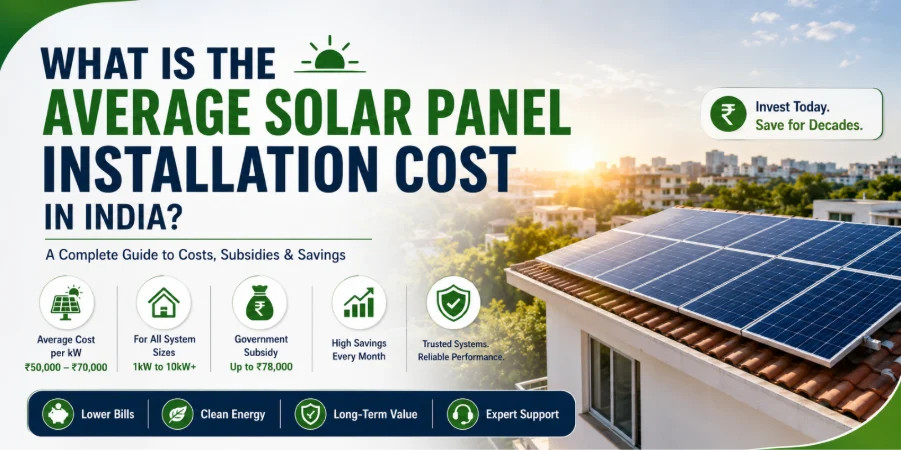
With subsidy support, the 3 kW solar system price in India with subsidy is significantly lower than the base cost, as the government covers a portion of the installation expense.
Subsidy for systems above 3kWe can go up to ₹78,000, reducing upfront costs considerably.
5kW solar system
A 5kW system is suitable for larger households or higher electricity consumption.
The 5 kW solar system price in India with subsidy benefits from similar subsidy caps makes it cost-effective for users looking for higher generation capacity.
Since subsidy limits are capped, the percentage benefit reduces slightly for larger systems, but the overall savings remain substantial.
State-Wise Solar Subsidy: What Changes?
While the central solar subsidy remains consistent across India, state-level differences come into play in:
- Implementation processes
- Additional incentives
- DISCOM approvals and timelines
- Net metering policies
Some states also provide additional top-up subsidies, especially for low-income households or specific categories, making solar even more affordable.
For example, certain state programs combine central subsidies with additional financial support to reduce the effective cost of installation even further.
This means that while the base solar panel subsidy structure remains the same, the actual cost experienced by users can vary depending on their location.

Combining Subsidy with Financing
While subsidies reduce upfront costs, they do not eliminate them entirely. This is where financing becomes important.
Many homeowners and businesses now combine solar panel subsidy benefits with structured financing options such as solar panel financing to make solar more accessible.
Options include:
- commercial solar loans for businesses
- Retail financing for residential users
- Flexible EMI-based repayment structures
By combining subsidy with financing, users can:
- Minimize upfront investment
- Install higher-quality systems
- Achieve faster return on investment
Role of Solar Finance Companies
A solar finance company plays a key role in bridging the gap between upfront system cost and affordability.
Even with subsidy support, many users hesitate due to the initial investment required. Financing solutions help spread this cost over time.
For residential users, financing options can complement the solar rooftop yojana, while businesses can use commercial solar loans to scale installations without affecting working capital.
This combination of subsidy + financing is increasingly becoming the standard approach to solar adoption in India.
Why the Right Ecosystem Matters
While subsidies and financing reduce cost barriers, the long-term success of a solar system depends on more than just installation.
Many solar projects face challenges such as:
- Delays in subsidy disbursement
- Poor system design
- Lack of performance visibility
- Fragmented vendor ecosystem
This is where integrated platforms play a crucial role. Aerem operates as a full-stack digital platform for solar adoption, helping streamline key aspects of the solar journey.
For users exploring subsidy-backed installations, access to solar financing, a procurement marketplace, and integrated monitoring systems ensures that solar systems are not only installed but continue to perform efficiently over time. Financing solar panels can further support users in managing upfront costs while enabling smoother adoption.
Final Thoughts
The availability of solar panel subsidy programs has made solar energy more accessible than ever before in India.
Schemes like the PM Solar Scheme and Solar Rooftop Yojana are accelerating adoption by reducing upfront costs and encouraging households to shift to renewable energy.
However, subsidy alone is not enough.
Combining subsidies with financing options such as commercial solar loans and working with a reliable solar finance company ensures that solar installations are not just affordable but also efficient and sustainable in the long run.
As India moves towards large-scale solar adoption, understanding how subsidies, financing, and system quality work together will be key to making the most of solar energy. Exploring region-specific benefits like solar subsidy in gujarat can further enhance savings and improve overall returns.






















.png)



.png)




.jpeg)
.jpeg)





.jpeg)










.jpeg)

.webp)
.png)
.png)
.png)
.png)
.png)

.png)
.jpg)
